A little set of stationery
Coordinate a letter sheet and an envelope liner.
Make a coordinated writing sheet and envelope liner using one repeat at two scales. Keep the writing area calm and use the pattern where it supports the page rather than competing with handwriting.
A result you can build toward
These are actual outputs of the studio’s drawing and repeat functions. They are reference compositions, not screenshots of physical products. Your hand-drawn marks will vary.
Download the reference tile ↓The download is the first example’s repeating unit, not the full preview. It opens in SVG-compatible applications; the studio does not import files.
A writing-sheet layout study
This digital composition is assembled from the reference artwork. It demonstrates the next layout step; it is not a photograph or a physical production test.
Download the layout study SVG ↓01 / Set up your drawing
Use Pencil size 12 in #557D9B with a few small Leaf stamps in #345B45. Start on #FAF8F1, offset 25%, scale 85%, and Pattern rotation 0°. For a lighter printed sheet, consider Transparent so the paper itself supplies the base color.
02 / Make the example
Draw three small curved sprigs and place a leaf beside each. Export SVG and assemble the writing sheet in a separate layout application. Keep the repeat in a narrow header or side panel, leaving a generous unpatterned area for writing. Add any name, address, or ruled lines in that application. Keyagain does not create text fields or page margins.
03 / Compare and refine
For the liner, use the same tile at a larger physical size so fewer motifs appear across the envelope. Trace the actual envelope's interior shape on scrap paper and test the fit before applying the pattern. Keep artwork and adhesive away from the flap's sealing area. The same colors and shapes connect the two items even when the motif size changes.
If the result feels off
If Pencil looks too pale in a proof, switch to a darker ink or use Pen for the next version. If the sheet feels crowded, reduce the patterned area instead of shrinking every motif until it becomes noise. An offset tile is twice as tall as wide: preserve that ratio when duplicating it into a header or liner shape.
Check the finished file
Print a single sheet and a plain liner template first. Test your usual pen on the paper and fold the liner into the envelope without glue before trimming a final version. This is a digital design exercise, so paper thickness, adhesive, and printer handling need your own tests. Keep the writing-sheet layout and liner template as separate files.
Visual inspiration
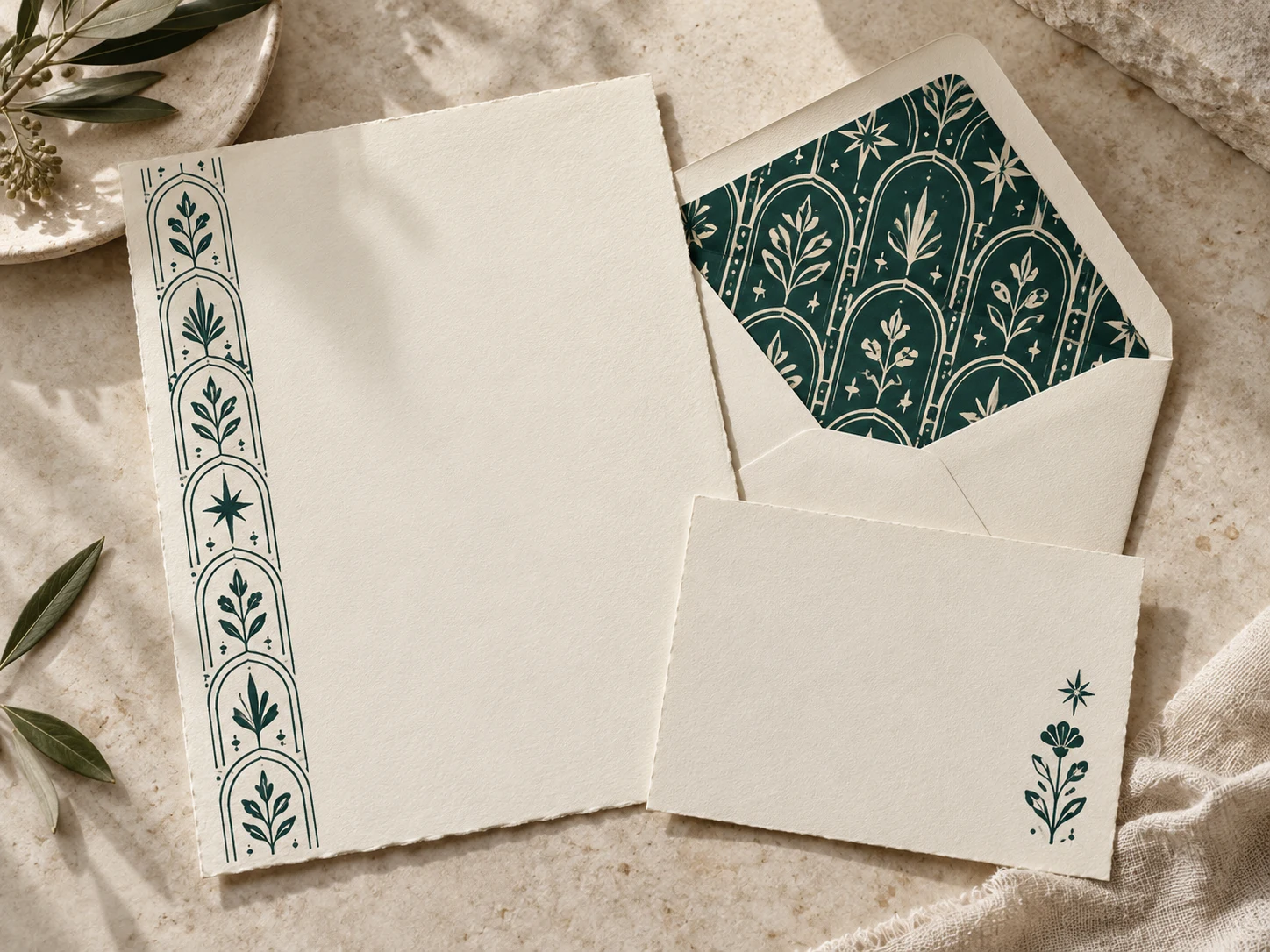
This AI-generated editorial image is a separate styling idea. Follow the studio-rendered examples above for achievable tool output. Physical materials and printing need your own tests.